Construction sites are one of the highest-risk environments for theft and vandalism in Northern Ireland. Plant machinery, tools, copper, and building materials disappear from sites regularly, particularly over weekends and bank holidays when sites are unmanned. PSNI figures consistently show construction and agricultural theft as leading categories of reported crime in rural and suburban areas.
The challenge is that most construction sites have no broadband, no permanent power in the early phases, and the layout changes week to week as the build progresses. Traditional CCTV installations are not designed for this. You need something temporary, self-contained, and remotely monitored.
How 4G Construction Site CCTV Works
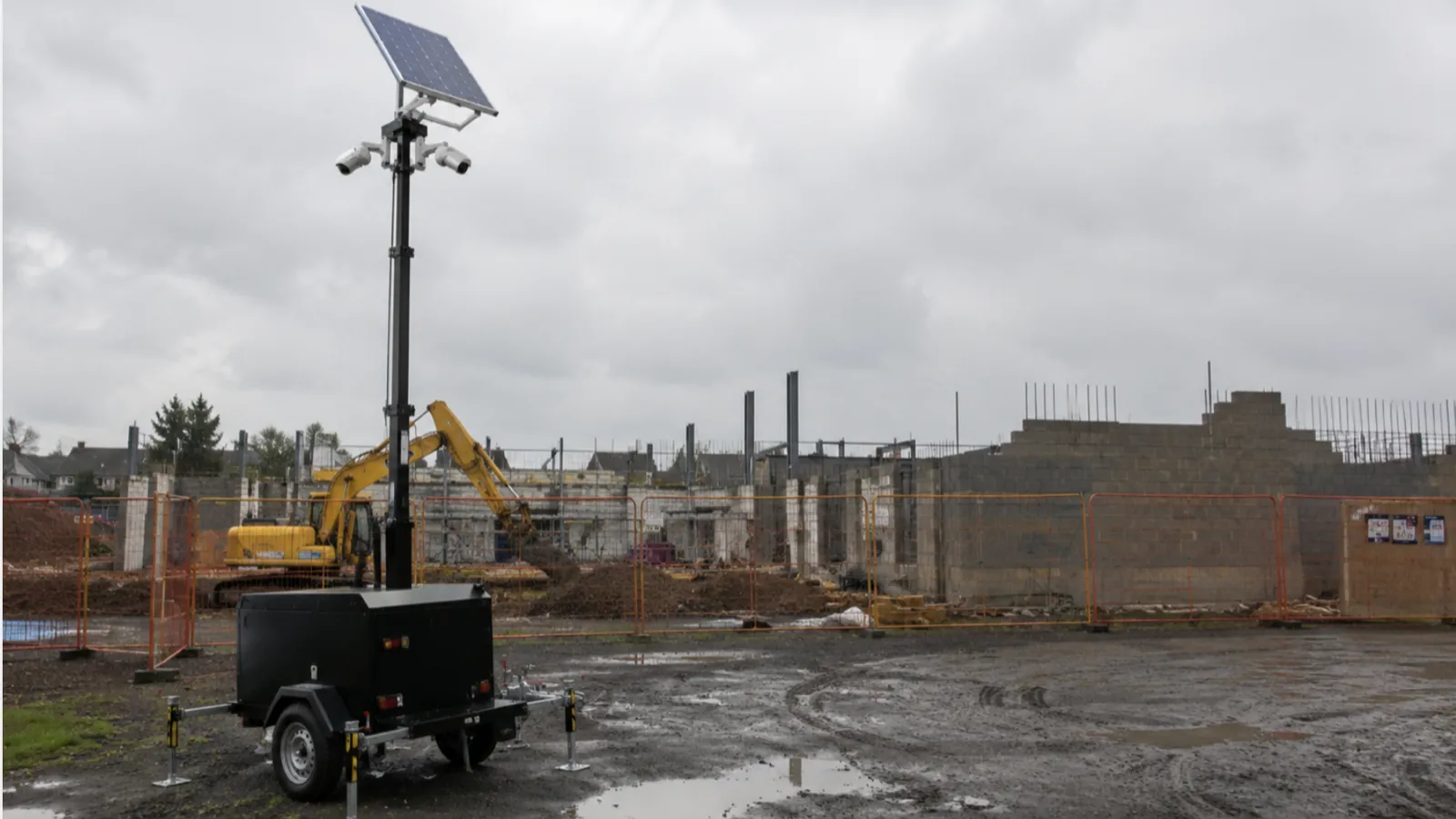
A 4G-connected CCTV system does not need site broadband. It uses a mobile data SIM (4G or 5G where available) to transmit footage to a remote viewing platform. The cameras, recorder, and cellular connection sit in a single self-contained unit that can be deployed in under an hour and moved as the site develops.
Typical setup:
- Rapid deployment tower (trailer-mounted or pole-mounted) with 2-4 cameras at 4-6 metre height
- NVR or SD card recording on-board for local storage
- 4G/5G router with external antenna for reliable cellular connectivity
- Solar panel + battery for sites without mains power (or mains connection where available)
- Remote viewing via mobile app and web dashboard
- Motion-triggered alerts pushed to your phone in real time
- IR illumination for night coverage (typically 50-80 metre range)
Temporary vs Permanent: When to Use Each
Temporary (4G tower systems)
Best for:
- Sites in early construction phases before mains power and broadband are connected
- Short-term projects (3-12 months)
- Sites that change layout frequently (the tower can be repositioned as building phases progress)
- Remote or rural sites with no fixed broadband options
- Situations where you need CCTV operational within 24 hours of signing the contract
Permanent (wired PoE systems)
Best for:
- Sites where mains power and broadband are already available
- Long-term projects (12+ months) where the system will be in place for the duration
- Sites that will become permanent premises (the CCTV transfers to the finished building)
- Larger sites needing 8+ cameras with continuous recording and high-resolution footage
Many projects start with a temporary 4G tower for the groundworks and shell phase, then transition to a permanent wired system once the building has power and data cabling installed. We handle both.
What to Look For in a Construction CCTV Provider
Things that matter:
- Coverage and signal check before deployment - not every site has usable 4G. A provider should verify signal strength at your specific location before committing to a 4G solution. Dead spots exist, particularly in valleys and behind hills in rural NI.
- Data SIM management - construction site cameras generate significant data, particularly with motion-triggered uploads and live viewing. Your provider should manage the SIM, monitor data usage, and use a specialist data-only multi-network SIM with access to supported partner networks for improved resilience.
- Weatherproofing - IP67 minimum for cameras. The NVR and electronics housing needs to handle rain, dust, temperature extremes, and the general abuse of a working construction site.
- Repositioning flexibility - as the build progresses, camera positions that covered the whole site in phase one may be blocked by new walls in phase two. Your provider should include repositioning visits in the contract.
- Evidence quality - the cameras need to produce footage that is usable by PSNI. That means clear facial identification at entry points, readable number plates on vehicle cameras, and timestamps that are accurate and verifiable.
Things that are marketing noise:
- "AI-powered intruder detection" on a £200 camera is motion detection with a different label
- "24/7 monitoring centre" often means a room of operators watching 500 sites on a video wall. Response time to your specific alert is measured in minutes, not seconds.
- "Unlimited cloud storage" typically comes with resolution limits or data throttling after a threshold
Power Options
Mains power (preferred where available)
If the site has a temporary supply connected, this is the simplest option. A standard 13A socket powers the entire tower unit. Run time is not a concern.
Solar + battery
For sites with no mains power. A solar panel charges a battery bank during daylight hours, and the system runs from the battery overnight. In Northern Ireland's climate, you need to factor in winter days with minimal sunlight. A properly sized system (200W+ panel, 100Ah+ battery) will run through December and January without issue on most sites. Undersized panels are the single most common failure point on solar CCTV installations here.
Generator backup
Some sites run a generator during working hours anyway. The CCTV system can charge from this and run from battery overnight. This is a pragmatic option for sites where solar panel mounting is difficult or theft of the panel itself is a concern.
Data and Connectivity
4G coverage across Northern Ireland is generally good in urban and suburban areas (Belfast, Lisburn, Newry, Armagh, Derry). Rural sites can be more variable. Before deploying, I test signal strength at the exact camera mounting height, because a signal that is marginal at ground level often improves significantly at 4-6 metres on a tower.
For sites with very poor 4G, options include:
- External high-gain antenna (directional, pointed at the nearest mast)
- Specialist data-only multi-network SIM with access to supported partner networks, selected according to site coverage and the required service profile
- Local recording only with periodic manual download (not ideal, but still provides evidence)
- Starlink for sites with clear sky visibility (higher latency but reliable bandwidth)
Insurance and Compliance
Many construction insurance policies now require CCTV as a condition of cover for unattended sites. Check your policy wording. Common requirements include:
- Cameras covering all entry/exit points
- Minimum 30-day recording retention
- Remote monitoring capability (not just local recording)
- Evidence of maintenance and operational checks
For GDPR compliance, you need signage at site entrances informing people they are being recorded, with your company name and contact details. If the cameras cover public footpaths or neighbouring properties, additional considerations apply.
Areas We Cover
Construction site CCTV deployment across all of Northern Ireland: Belfast, Lisburn, Newry, Armagh, Craigavon, Bangor, Newtownards, Ballymena, Derry/Londonderry, Omagh, Enniskillen, Dungannon, Cookstown, and everywhere in between. For large or remote sites, we do a signal survey before quoting to confirm 4G viability.
Get Construction Site CCTV Quoted
Tell me the site location, how long the project runs, and what you need covered. I will check 4G signal, recommend temporary or permanent, and give you a fixed quote.