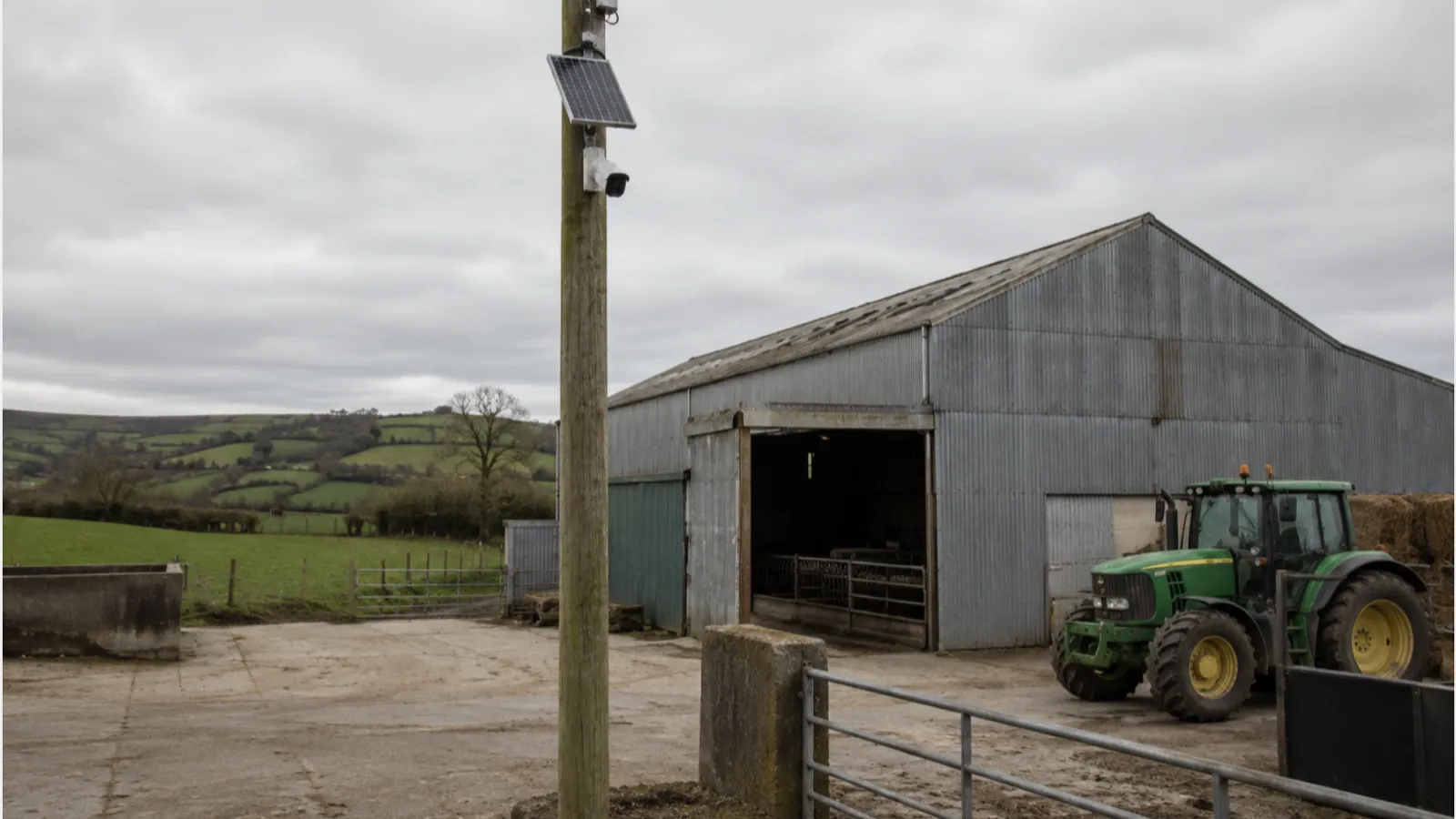
Farm theft in Northern Ireland is not a minor problem. Machinery, fuel, tools, quad bikes, livestock trailers, and copper wiring disappear from farmyards regularly. Rural properties are targeted precisely because they are isolated, often unlit at night, and historically unmonitored. PSNI rural crime figures consistently show agricultural theft as a leading category.
The good news is that farm CCTV has become practical even on sites with no broadband and limited power. 4G-connected cameras, solar-powered systems, and modern infrared technology mean you can cover a farmyard effectively without running cables to every building.
What Farm Cameras Need to Cover
Farmyard and entrances
The main yard and any vehicle entrance or exit point. This is where most theft occurs and where number plate capture is most useful. A camera covering the lane or gateway gives you footage of every vehicle that approaches the property.
Sheds and barns
Particularly those containing machinery, tools, or stored fuel. Internal cameras inside sheds catch anyone who gets past the perimeter. External cameras covering shed doors and roller shutters show entry attempts.
Fuel storage
Diesel theft is one of the most common farm crimes in NI. A camera covering the fuel tank, ideally with motion-triggered alerts, gives you instant notification when someone approaches at unusual hours.
Machinery parking areas
Tractors, telehandlers, quad bikes, and trailers left outside are targets. Coverage of parking areas, particularly approaches from public roads, is a priority.
Livestock areas
Calving sheds, lambing pens, and paddocks near public roads benefit from cameras both for security and stock monitoring. Many farmers use cameras as much for lambing watch as for theft prevention.
Remote entrances and field gates
Field gates on back lanes are often how thieves access a property without being seen from the house. A camera at a remote gate is harder to install (no power or broadband) but 4G battery cameras have made this feasible.
The Broadband Problem on Farms
Most farms in Northern Ireland have poor broadband. Some have none at all. This used to mean CCTV was either impossible or limited to local recording with no remote viewing. That has changed.
Options when broadband is poor or absent:
- 4G cameras with built-in SIM slots - each camera has its own mobile data connection. No broadband needed. Works anywhere with 4G signal.
- 4G NVR with local cameras - cameras connect to a recorder via cable or local Wi-Fi, and the recorder uses a 4G SIM for remote viewing and alerts. More bandwidth-efficient than individual 4G cameras.
- Starlink - for farms with clear sky visibility, Starlink provides 50-200Mbps broadband via satellite. Enough for a full wired CCTV system with remote viewing. Higher ongoing cost but reliable where 4G is not.
- Local recording only - if there is genuinely no mobile signal and no satellite option, cameras can still record locally to an NVR or SD card. You lose remote viewing but still have evidence after an incident.
Before recommending a solution, we test 4G signal strength at the camera locations (not just the farmhouse). Signal at 4 metres on a pole is often significantly better than signal at ground level behind a stone wall.
Power Options for Farm CCTV
Mains power (where available)
If power is available in sheds or near camera positions, this is the simplest and most reliable option. PoE (Power over Ethernet) means one cable carries both power and data from the NVR to the camera, up to 100 metres. No separate power supply at the camera location.
Solar + battery
For cameras on field gates, remote lanes, or positions far from any building. A solar panel charges a battery during daylight, and the camera runs from the battery at night. In NI's climate, a properly sized panel (100W+ for a single camera) works year-round, including winter. Undersized panels fail in December and January.
12V from existing supplies
Some farm buildings have 12V lighting or fencing circuits already. Certain cameras can run directly from 12V DC, avoiding the need for mains conversion.
Night Vision and Lighting
Farms are dark at night. There are no street lights. Camera infrared range matters far more on a farm than in a lit car park.
- Standard IR (30m) - adequate for shed doorways, fuel tanks, and close-range coverage
- Extended IR (50-80m) - needed for yard coverage and longer driveways
- Supplementary IR illuminators - separate infrared floodlights that extend camera range without visible light. Useful for covering large yards where camera IR alone is not enough.
- White light deterrent - some cameras have a white LED spotlight triggered by motion. The sudden light itself deters intruders and provides colour footage at night. Can be useful but may annoy neighbours or livestock depending on placement.
Motion Detection and Alerts
On a farm, basic motion detection triggers constantly: animals, birds, vehicle headlights on a distant road, trees blowing. If every motion triggers a phone alert, you stop checking them within a week.
Better systems use:
- Human detection - AI that distinguishes people from animals. Not perfect but significantly reduces false alerts.
- Vehicle detection - alerts only when a vehicle enters the frame. Useful on driveways and lanes.
- Line crossing - draw a virtual line across the entrance. Only triggers when something crosses it, ignoring activity further away.
- Scheduled detection zones - reduce sensitivity or disable alerts during working hours when the yard is busy, and increase sensitivity overnight.
What We Check Before Recommending Farm CCTV
- Where the cameras need to see (coverage areas and distances)
- Whether there is power nearby (mains, solar, or 12V options)
- Whether broadband is available (and its upload speed)
- Whether 4G/5G signal is usable (tested at mounting height, not ground level)
- How footage will be recorded (local NVR, SD card, or cloud)
- Whether remote viewing on a phone is required
- Whether there are dark areas needing infrared or supplementary lighting
- Whether cameras need to cover yards, gates, sheds, or machinery
- How exposed the equipment will be to weather, dust, and livestock interference
- Whether warning signs or privacy considerations apply (public road visibility, neighbouring properties)
Common Farm CCTV Mistakes
- Buying cameras before checking power and broadband - the cameras are the easy part. Getting power and connectivity to the right locations is where most installations fail or become expensive.
- Relying on Wi-Fi too far from the router - Wi-Fi does not penetrate stone walls, corrugated steel sheds, or cross open farmyards reliably. If the camera is more than 20 metres from the access point with obstructions, use a cable or a dedicated point-to-point wireless link.
- Not covering entrances and exits - internal shed cameras are useful but if you do not cover the approach road or yard entrance, you miss the vehicles used to take your property.
- Forgetting night-time visibility - a camera that produces clear footage at 2pm is useless if its IR range cannot cover the same area at 2am.
- Not checking recording storage - if the NVR only holds 7 days of footage and you do not check it for two weeks, the evidence is overwritten before you notice the theft.
- Using consumer cameras in harsh outdoor areas - consumer Wi-Fi cameras (Ring, Nest) are not built for farmyard conditions: dust, moisture, temperature extremes, and livestock interference. IP67-rated commercial cameras are.
- Not planning remote access securely - cameras accessible from the internet need proper security. Default passwords and port forwarding on cheap NVRs are routinely exploited. We isolate CCTV on its own network segment with secure remote access.
Privacy and Signage
If your cameras capture any public road, footpath, or neighbouring property, you have GDPR obligations. Even on private farmland, clear signage is required stating that CCTV is in operation, who operates it, and how to request access to footage. This does not need to be complicated, but it does need to be visible at entry points.
Where We Install
Farm CCTV installation and site surveys are available across Northern Ireland. Some camera systems can be monitored or supported remotely after installation. We cover farms and rural properties throughout County Antrim, Down, Armagh, Tyrone, Fermanagh, and Derry/Londonderry.
Book a Farm Site Survey
Tell me what you need covered and I will come out to check power options, 4G signal, and camera positions. Fixed-price quote with no obligation. All of Northern Ireland.
Related
- CCTV installation Belfast: what to expect
- Construction site CCTV Northern Ireland
- CCTV installation service page
- Best 5G routers for business - relevant for 4G/5G farm connectivity